Posts mit dem Label digital preservation werden angezeigt. Alle Posts anzeigen

Donnerstag, 16. März 2023

Some thoughts about a minimalistic Archival Information System, part 3

 In the last blog post we considered what the basic structure of the information packages should look like and how we will deal with versioning. In the following I would like to describe further cornerstones of a minimalistic archival information system. These will then form the basis for a first implementation, which would go beyond the scope of this blog. As soon as there is news worth reporting, I will announce it here.

Data management

Other archival information systems sometimes make it too easy for themselves and use a database to manage information about the AIPs in the archive. In principle there is nothing wrong with this, but it often seems that it is forgotten that a basic principle of information packages is the intellectual unit (IE) of data and metadata. What does this mean? The idea is that an IE should be able to stand on its own at all times. Following this principle has two consequences. First, hierarchically nested IEs cannot exist unless self-contained IEs are encapsulated like a box of boxes. In other words: IEs that only contain references to other IEs are not possible because they would not be viable on their own.  

The second consequence is that all metadata must always be in a consistent state, regardless of the state of the archive information system. In other words, there must be no contradictions between the information stored in the AIP and the information in the system's database.

Why is this important? The Archival Information Packages are ultimately the time capsules that will outlast the Archive. If everything breaks, but a copy of an AIP is still found on tape, it contained all the information needed to interpret the data to be preserved.

So for the management of the AIPs we define the following:  

  1. the AIP is the basis for everything. If there are inconsistencies in the archival information system, we first ask the AIPs.
  2. In order to speed up the processing, we can use a database. But then there must be a way to generate the database from the AIPs.
  3. If the AIP is the basis for everything, then we need a mechanism that ensures that if there are errors in the creation of an AIP or in the creation of a new AIP version, these can be rolled back. 
  4. The archive can and should only assume responsibility for the data entrusted to it if an AIP or a new AIP version could be successfully generated.

Things that make life easier

What has proven to be very helpful is the following: 

  1. We should only allow 1:1 mappings. This means that a SIP contains exactly one digital object 
  2. We do without nested IEs.  
  3. We ignore for now that copy operations are expensive. It follows that AIP updates always consist of SIPs with complete data and metadata.

Architectural decisions

A minimalist archival information system (MAIS) should have the following properties:

  • Implemented as open source for study, improvement and reuse
  • Command line oriented so there is a clear interface.
  • Concentration on the essentials, therefore no routing, but suitable for parallel use.
  • Fast and small enough not to waste resources.
  • Avoiding XML to keep code simple and metadata human-readable
  • BagIt as base for SIPs, AIPs and DIPs
  • Preservation Planning and Action as an external operation on a set of AIPs
  • Implementation in a programming language that can be used for all common operating systems without contortions.

And now?

I plan to tackle the programming in the coming weeks and months. I will probably not go into detail about the individual steps of programming here. As soon as there is something presentable, I'll let you know. Otherwise let me know what your experiences are, which details are important to you with an AIS, especially if it should be particularly lightweight.


Donnerstag, 2. März 2023

Some thoughts about a minimalistic Archival Information System, part 1

Many of those who are dealing with the digital preservation of objects for the first time and who work in small memory organizations are often helpless in the face of the vast range of functions and requirements of current archival information systems.
Students of library or archival science often appear to be similarly overwhelmed when they are supposed to learn what constitutes archival software.

This has motivated me to write down thoughts on a minimalist archive information system. Because it really doesn't need much.

The basic terms

An archive essentially has three roles: the submitter, called the producer, the user, also called the consumer, and the problem solver who maintains the archive, also called the technical analyst.


When digital objects are transferred to the archive, it is called the ingest process. When they are requested from the archive, then this is the access process. 

The digital objects to be preserved are provided with all the necessary information for the archive ingest and are packaged in a predefined structure. This is called a Submission Information Package (SIP). You can actually imagine this just like in real life. For example, if you want to store a vase, you put it in a box, label it and put it on a shelf.

In the archive it is checked whether (allegorically) the vase is in the box and intact, and if there is a stamp and signature that says that the content of the package is indeed a vase. A file number and a storage location is assigned and the box goes sealed and neatly labeled on the shelf. The "box" is called Archival Information Package (AIP). With the seal, the archive takes responsibility.

At some point, when the user would like to see the vase from the archive again, the archive would process the request and send the vase and accompanying information to the user. This is then called a Dissemination Information Package (DIP).

In addition to this simple "I store something safely and retrieve it again at some point" approach, an archive fulfills another task that is not so obvious: it ensures that objects entrusted to it are kept usable. 

What does that mean in the digital world?
If it is possible in principle to store a digital object securely with bit accuracy, even over a very long period of time (bitstream archival), it still can age because the environment for using this object is no longer available.

There are essentially three concepts for keeping digital objects usable (content preservation): hardware museum, emulation or format migration. 

Hardware museums (e.g. a slot machine museum) try to keep old equipment running in a controlled environment. To do that, they have to build up a stock in time and build up knowledge on how to maintain and repair these devices.

With an emulation, I try to recreate the environment for the digital object so that it feels at home and doesn't notice any difference from the previous, real world. A very good example of emulators is e.g. MAME, but also various others, the e.g. retro computers like the Amiga or C64, so that old programs from their time can run on them. Here, too, I need knowledge about what the environment to be emulated looks like and how I can recreate it with today's means.

When migrating the format, I try to find a new form that retains the essential properties (significant properties) in good time and to transfer files from a digital object to a newer data format.

From this point onwards, it is assumed that this is the preferred way of maintaining usability.

It follows that an Archival Information System (AIS) must be able to support this process of format migration. The process (also called Preservation Planning and Action) results in a new version of the Archival Information Package being created. The AIS must be able to manage this.

That would basically be all there is to Archival Information Systems if it hadn't been for the librarians.

Unlike archivists, where a record is complete and closed, librarians understand the concepts of supplements and metadata submissions. A page that has fallen out has turned up here, a letter has been discovered there in an estate, or it has dawned on some people that there is now money for costly in-depth indexing. Ergo, librarians expect people to think about how to handle metadata and data updates on existing AIPs (called metadata update and AIP update). This is not trivial, since some AIPs are also very large and you want to avoid pointless copying. For such an update, we also need a good way for producers to tell the archive which AIP needs to be added or updated.

However, AIPs are already versioned in the case of format migration, the same can be used here as well. Any change to the AIP creates a new version of an AIP. And so that you can't accidentally break anything, you should always be able to go back to an old version. And since that is also error-prone, the result of the rollback process will simply be a new version. 

 That's it. It's nothing more. Easy, isn't it?


Donnerstag, 1. April 2021

Backup is digital long-term preservation!

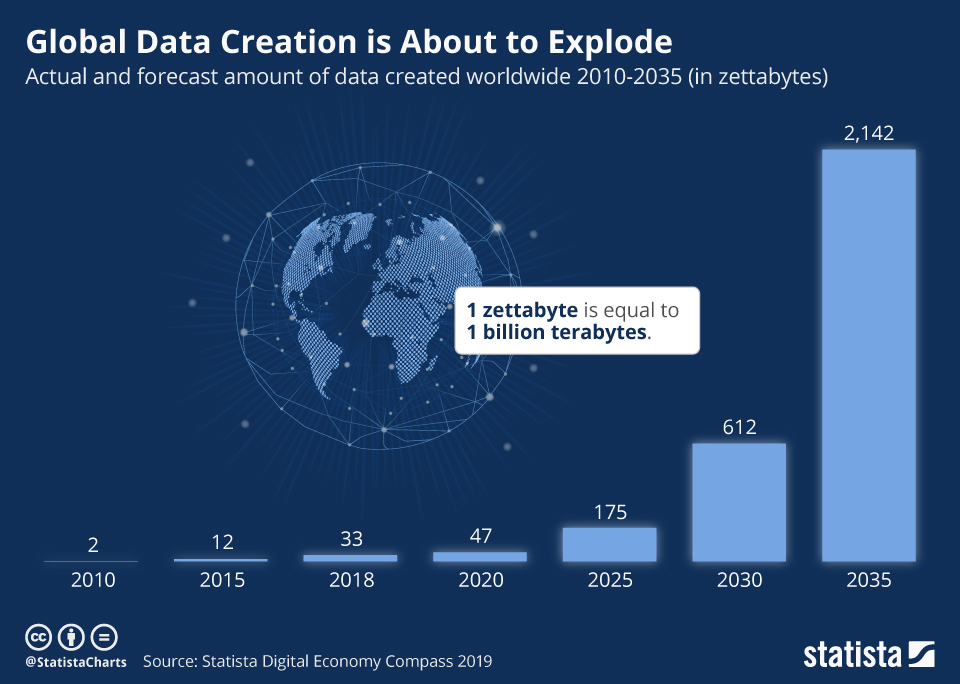
Exponential growth

https://www.statista.com/chart/17727/global-data-creation-forecasts/

An important observation is that the number of files produced each year continues to increase worldwide (see https://en.wikipedia.org/wiki/Information_explosion). And with it the number of digital objects increases in the same measure, for which we must decide: Keep or throw away? 

The truth is, the discard scenario becomes the more likely one with each passing year.

Magnificent diversity

 Another observation is that about 90 new file formats are added every year.
And the file formats that are being dropped are already in place. 


The truth is, no one can build up format knowledge for this yet.


A fuzzy concept

When talking to colleagues, the topic of validation does not play a role. For one thing, no one is clear about what "valid" means. Valid against a specification? Valid against a profile? Valid because it can be opened by programs? On the other hand, nothing happens after that. If a file is broken, it is still archived. If it is not broken, fine. 

The truth is, validation is useless.


Success factors

Do you know how the success of digital preservation is measured? I'll tell you, in terabytes per year. If the numbers go up, that's a good thing to sell to politicians. Whether it was difficult to prepare digital objects for long-term availability doesn't matter. Whether born-digitals are more at risk, never mind. 

Is that the truth?

Overrated

It used to be said that long-term digital archiving could only be handled by organizations with a minimum of resources. Look around and you'll find dozens of one-man orchestras and part-time archives. And do you think that as the amount of data increases, so do the human resources? Oh, come on! 

 You know the truth!

That's too exhausting

If you've ever heard of format migration as a principle of long-term preservation, you've read in textbooks phrases like 

To ensure format migration, the significant properties of groups of objects that must be preserved must be determined. 

Have you ever seen an archive that has actually determined and documented significant properties? 

The truth is, significant properties are determined after the fact from technical metadata.

Summary

So what is digital long-term preservation? Only an expensive backup.